

- Size: Maximum overall length reaches 1,280 mm in females; the longest males reach 1,124 mm . Most adult individuals encountered are between 80–100 cm long .
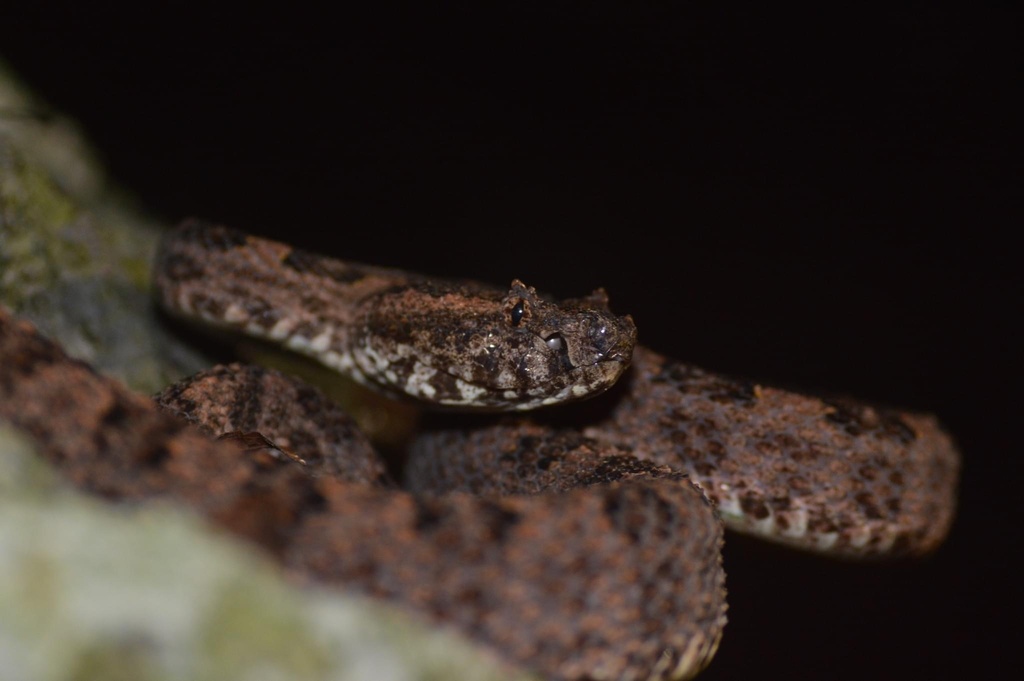
- Coloration: The dorsal and flanks vary in color from gray to reddish-brown. The pattern consists of 40–45 large, irregular rectangular spots, dark brown, sometimes with a lighter center or black border. The tail has 15–26 dark spots on either side of the back. The head is brown to chestnut brown with irregular black mottling. The belly is cream or light gray with numerous round or irregular brown spots on each ventral scale. Juveniles have a similar but more contrasting pattern.
- Head: The head is triangular, large, elongated, thick at the rear, and very distinct from the neck. The muzzle is long and flat ; the eyes are small with vertically elliptical pupils . The upper surface of the head is brown, dark brown, or dark chestnut, irregularly mottled with blackish-brown. There are dark brown streaks on either side of the head behind the eyes.
- Body: Slender, slightly flattened body.
Protobothrops mucrosquamatus
Protobothrops mucrosquamatus
- Poisonous
- Do not touch.
- Snake repellent is ineffective.
The beaded viper has the scientific name Protobothrops . mucrosquamatus Cantor , 1839 is a species of snake belonging to the viper family ( Viperidae ), genus Protobothrops .
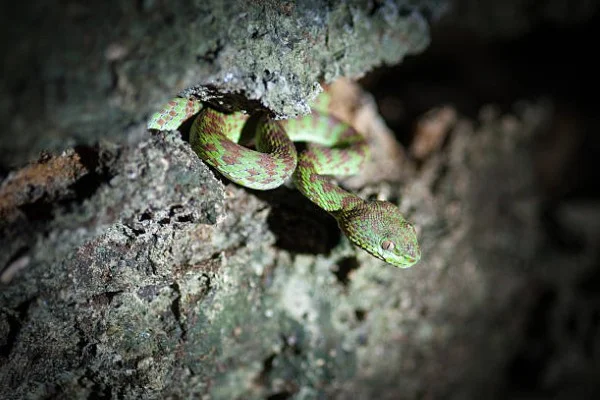
- Habitat: This species is primarily nocturnal, usually active from 7:00 PM to 5:00 AM , peaking around midnight. It can tolerate temperatures as low as 5°C (in Tam Dao) to 13°C . It lives in evergreen forests, mixed forests, tea plantations, and even near residential areas (often found in plant debris, gardens, or ancient stone walls). This species is both terrestrial and a skilled climber (semi-terrestrial, semi-arbiter). It moves slowly but can be very agile when needed.
- Oviparous species . Females lay 5 to 13 eggs (a record of 24 eggs was recorded in Japan). Newly hatched juveniles average 250 mm in length (males) and 306 mm (females).
- Food: Diverse food sources. Studies in China and Taiwan show that: 9% are small mammals (mice, shrews), 15.2% are amphibians , 8.5% are other snake species , and 3.4% are birds . It is particularly hungry in August.
1
Reassure the victim
Keep the victim still and limit movement to slow the spread of the venom. Do not allow the victim to walk around.
2
Immobilize the wound
Clean the bite wound with soap and water. Apply a light compression bandage (not a tourniquet) above the bite, keeping the bitten area lower than the heart.
3
Go to a medical facility
Transport the victim to the nearest hospital as soon as possible. If possible, take a picture of the snake so the doctor can identify the appropriate antivenom.
DO NOT cut the wound, DO NOT suck out the venom, DO NOT apply folk remedies.
The pit viper is a dangerous venomous snake that can be fatal (recorded in China and Taiwan). Its venom contains potent cytotoxic and hemotoxic substances , as well as mild neurotoxicity. It causes immediate acute pain, bruising, blistering, and widespread severe swelling leading to edema of the entire bitten limb. Tissue necrosis frequently occurs. Systemic symptoms include dizziness, nausea, fever, acute abdominal pain, and severe coagulation disorders , leading to bleeding gums and internal organ hemorrhage (liver, kidneys, brain). Hypovolemic shock due to blood loss is the leading cause of death.
SPECIES INFORMATION
Surname:
Protobothrops
Snake species:
Protobothrops
Species:
Viperidae
Common name:
Protobothrops mucrosquamatus
Nameplate:
Protobothrops mucrosquamatus
Distribution area
Paracel Islands
Spratly Islands
Distribution: Extends from the northern provinces to some provinces in the Central Highlands.
Other images