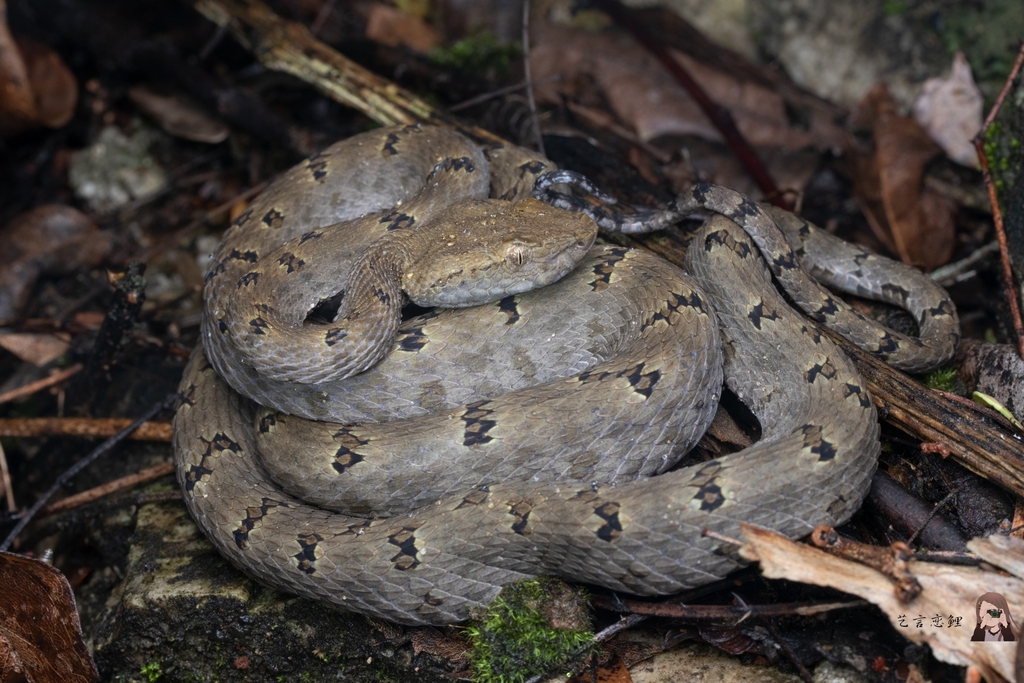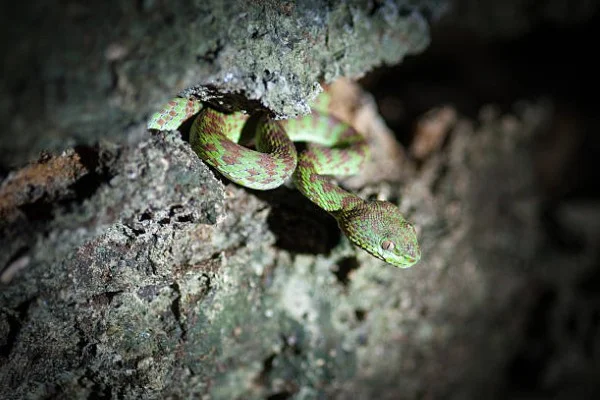


- Size: The maximum overall length reaches 1,255 mm for males; the longest females reach 1,052 mm . In Laos, an unpreserved specimen over 140 cm long has been found .
- Color: The dorsal surface is yellowish-gray, grayish-brown, or light brown. There is a series of 55–60 large , rhomboid or irregular spots on the back, dark gray or purplish-black, with a lighter center and a thin yellow border. The head is dark brown or black on top, irregularly mottled with pale cream. There is a distinct dark brown-black stripe behind the eye socket.
- Head: The head is triangular, large, elongated, and wide at the rear, distinct from the neck. The muzzle is long, slightly upturned at the tip, and somewhat blunt when viewed from above. The eyes are small, with small brown or dark brown spots, a horizontal brown streak in the middle, and vertically elliptical pupils .
- Body: The body is slender and slightly flattened. The tail is medium-sized, tapering and ending in a pointed scale.
Protobothrops sieversorum
Protobothrops sieversorum
- Poisonous
- Do not touch.
- Snake repellent is ineffective.
The three- ridged pit viper has the scientific name Protobothrops . sieversorum Ziegler , Herrmann , David , Orlov & Pauwels , 2001. It is a species of viper ( Viperidae ), genus Protobothrops . This is an endemic species of snake in the Indochinese Peninsula, recorded only in Laos and the former Quang Binh province (Vietnam).
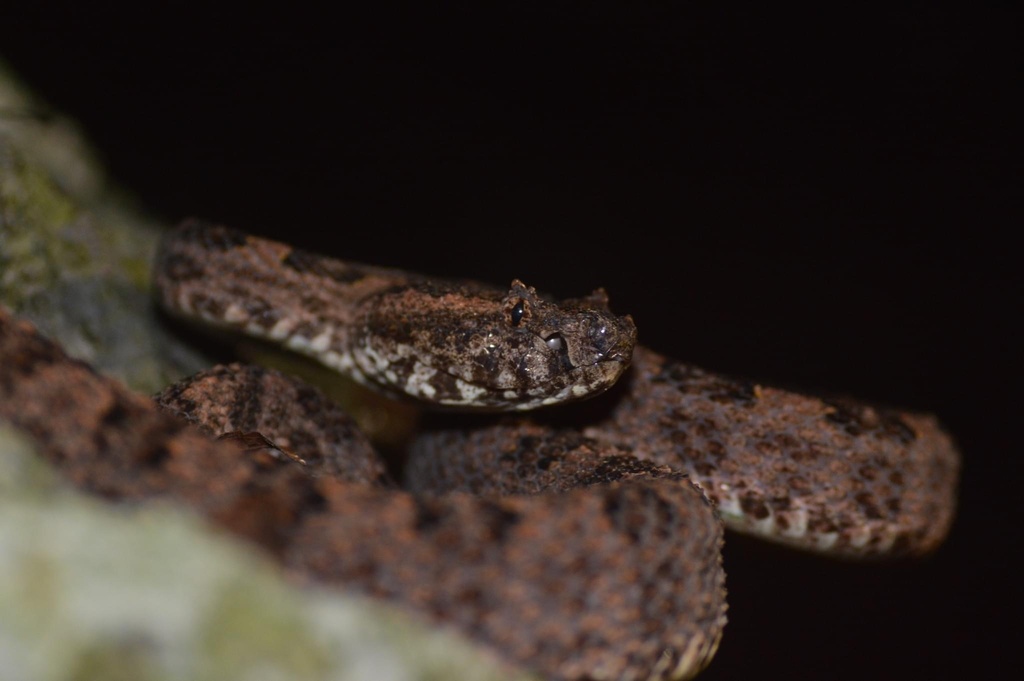
- Habitat: Nocturnal but also prone to morning sunbathing, this species is both ground-dwelling and semi-arthropod. It has been seen in thickets and low trees, as well as on limestone outcrops, although it may be more ground-dwelling than arboreal. In Vietnam, individuals are found in the leaf litter of the forest floor bordering these outcrops or among the vegetation growing there. In limestone structures, this species finds many cracks and crevices to hide in. The pattern on its back helps it camouflage perfectly on moss-covered rocks or among leaf litter. However, this snake is also frequently found foraging on the bare ground in cool limestone caves, even in complete darkness hundreds of meters from the entrance.
- Food: Their diet consists mainly of small mammals and possibly birds. In limestone caves, they are likely to hunt bats for food.
- Reproduction: Egg-laying. The exact reproduction process in the wild is not fully understood, but in captivity, they can lay up to 12 eggs, which hatch after 60-63 days.
1
Reassure the victim
Keep the victim still and limit movement to slow the spread of the venom. Do not allow the victim to walk around.
2
Immobilize the wound
Clean the bite wound with soap and water. Apply a light compression bandage (not a tourniquet) above the bite, keeping the bitten area lower than the heart.
3
Go to a medical facility
Transport the victim to the nearest hospital as soon as possible. If possible, take a picture of the snake so the doctor can identify the appropriate antivenom.
Although there have been no recorded cases of snakebites by P. sieversorum but their large size, long fangs, and relationship with other Protobothrops species such as the pit viper are significant factors. Protobothrops The mucrosquamatus is definitely a highly venomous snake and requires medical attention if bitten.
Venom of P. sieversorum It has cytotoxic effects , causing damage to tissues and blood cells; it is also hemotoxic , affecting the blood clotting process.
SPECIES INFORMATION
Surname:
Protobothrops
Snake species:
Protobothrops
Species:
Viperidae
Common name:
Protobothrops sieversorum
Nameplate:
Protobothrops sieversorum
Distribution area
Paracel Islands
Spratly Islands
Distribution: Formerly Quang Binh province, now part of Quang Tri province.
Other images