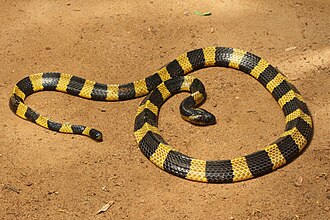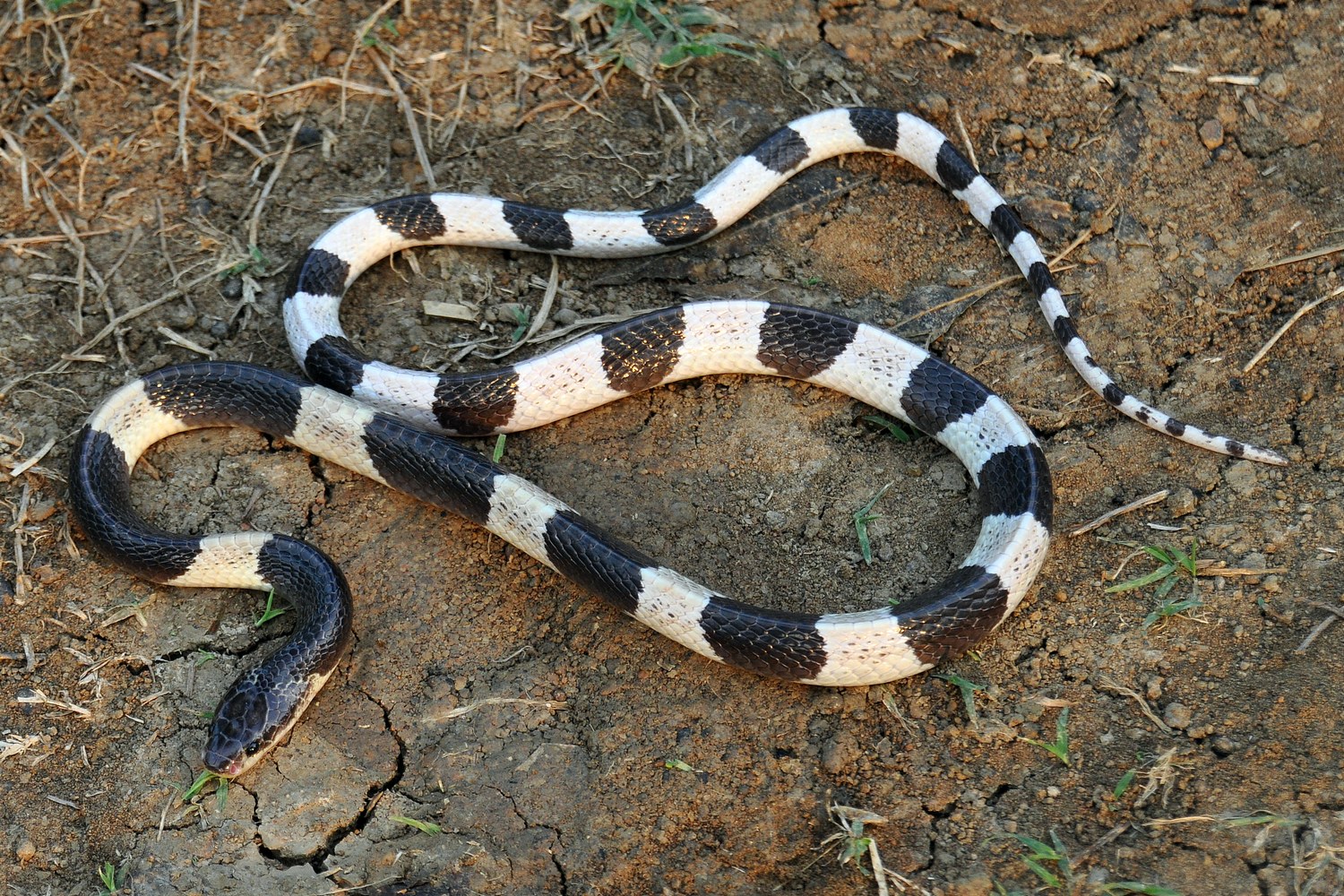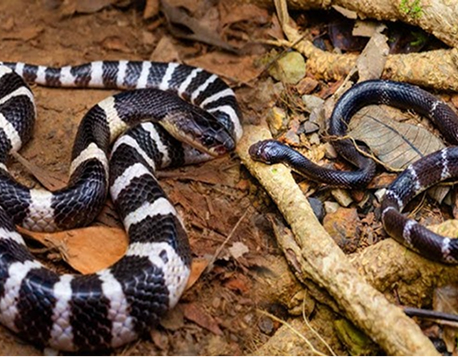


- Size: Krait snakes can reach a size of 225 cm , but most individuals found are between 130 and 150 cm long.
- Coloration: The dorsal surface is yellow or light yellowish-brown (sometimes cream-colored). The body has 16–28 black segments, extending down to the edge of the ventral scales. There is a broad black band on the nape and neck. The head is dark brown or black, mottled with yellow. The upper lip scales are dark brown in front and yellow behind. The belly is cream-yellow or light yellow with black segments corresponding to the dorsal surface. The tail has 2–4 black segments.
- Head: Oval-shaped, short, thick, and distinctly separate from the neck. Muzzle is short and blunt when viewed from above. Eyes are small with round pupils.
- Body: The body is stocky, triangular in cross-section with a distinct dorsal ridge. The tail is short, thick, and truncate at the tip.
Bungarus cf. fasciatus
Bungarus cf. fasciatus
- Poisonous
- Do not touch.
- Snake repellent is ineffective.
Bungarus cf. fasciatus has the scientific name Bungarus. cf. fasciatus Schneider, 1801, is a venomous snake species belonging to the Elapidae family, genus Bungarus.
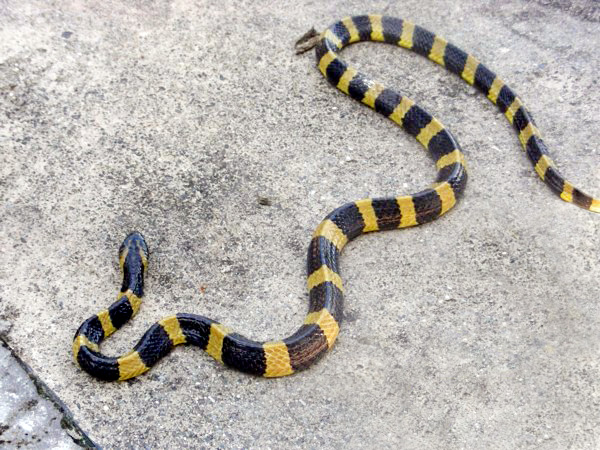
- Habitat: The banded krait lives in a variety of habitats: from evergreen forests and monsoon forests to agricultural areas, near rice paddies and villages. Its distribution ranges from sea level up to 2,300 m. This species is highly active at night, although it may occasionally forage during the day. During the day, they are usually sluggish, shy, and docile, hiding under piles of wood, in holes in the ground, or under vegetation. However, at night they become more agile and unpredictable.
- Reproduction: They are oviparous (laying eggs). The female lays 4 to 19 eggs and protects the nest by coiling around them until they hatch. The hatching period is approximately 60 days. Newly hatched snakes are about 250–400 mm long .
- Diet: Primarily feeds on other snakes, lizards, frogs, and small mammals.
1
Reassure the victim
Keep the victim still and limit movement to slow the spread of the venom. Do not allow the victim to walk around.
2
Immobilize the wound
Clean the bite wound with soap and water. Apply a light compression bandage (not a tourniquet) above the bite, keeping the bitten area lower than the heart.
3
Go to a medical facility
Transport the victim to the nearest hospital as soon as possible. If possible, take a picture of the snake so the doctor can identify the appropriate antivenom.
DO NOT cut the wound, DO NOT suck out the venom, DO NOT apply folk remedies.
Bungarus cf. fasciatus is a dangerous venomous snake with potent neurotoxin, although less potent than the southern krait. Its venom contains components that bind irreversibly to acetylcholine . The initial bite is almost painless, with only mild pain and minimal bleeding. This is followed by systemic symptoms such as headache, drooping eyelids, muscle stiffness, high blood pressure, progressive paralysis of muscle groups, and death due to respiratory failure.
SPECIES INFORMATION
Surname:
Elapidae
Snake species:
Bungarus
Species:
Elapidae
Common name:
Bungarus cf. fasciatus
Nameplate:
Bungarus cf. fasciatus
Distribution area
Paracel Islands
Spratly Islands
Distribution: Widely distributed throughout the country.
Other images